
Become a PR Powerhouse
Précis Best Practices, Tips and Shortcuts
 Back to Catalogue
 Blog
Blog
Listen to this blog with one of our AI generated voices.
Harvard Business Review Hits the Mark
In modern business, a new technological revolution is quietly reshaping how we work. Generative AI, once a concept confined to science fiction, has emerged as a powerful tool that has started to transform many industries. As reported in a recent Harvard Business Review article by H. James Wilson and Paul R. Daugherty, companies that have embraced this cutting-edge technology are experiencing remarkable improvements in efficiency, creativity, and overall productivity.
The integration of generative AI into daily workflows has quickly become a necessity for businesses aiming to maintain a competitive edge in today’s fast-paced market. According to the HBR article, early adopters of generative AI have reported staggering productivity gains of up to 40% in certain tasks, particularly in content creation, data analysis, and customer service. In public relations, for example, Précis AI recently released data from the users of Précis Public Relations reporting a per-task time savings of 61% and over 8 hours saved weekly. This substantial increase in efficiency allows employees to shift their focus to higher-value activities that require uniquely human skills such as emotional intelligence, creative problem-solving, and strategic thinking.
Fostering Human/AI Partnerships
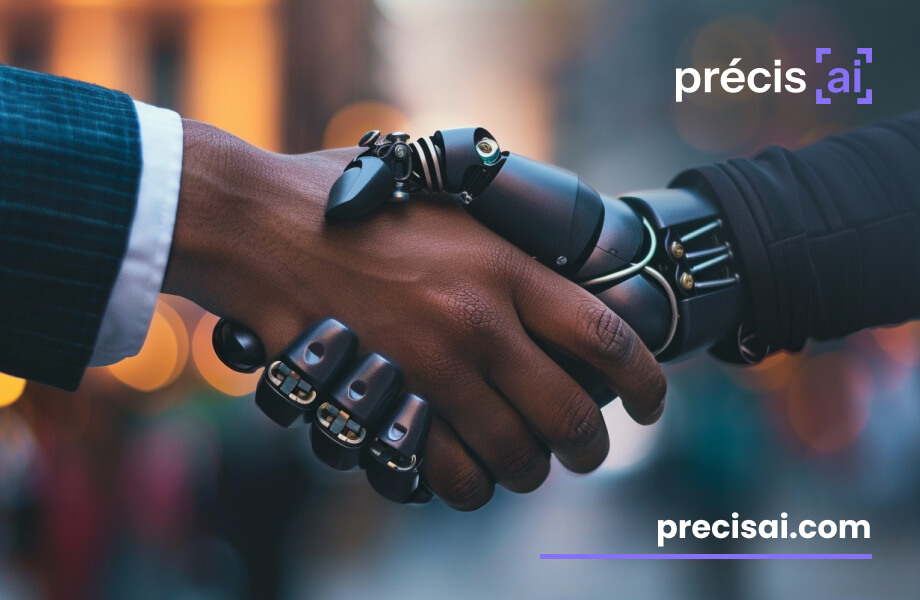
One of the key findings highlighted in the HBR article is the critical importance of adopting a human-centered approach to AI implementation. In the article, Wilson and Daugherty observe how, “The most successful organizations are those that view AI as a tool to augment human capabilities rather than replace them.” This perspective encourages a symbiotic relationship between humans and AI, where each entity complements the other’s strengths. By fostering this collaborative approach, companies can harness the full potential of generative AI while still leveraging the irreplaceable value of human insight and creativity.
AI Literacy is Essential
The article also underscores organizations’ need to cultivate “AI literacy” among their workforces. This concept extends beyond technical training and encompasses the development of a culture that embraces continuous learning and adaptation. Companies that invest in upskilling their employees to work alongside AI systems position themselves at the forefront of innovation. This investment enhances the capabilities of individual workers, while creating a more resilient and adaptable organization.
Creative Industries like PR & AI
Interestingly, the HBR study reveals that the benefits of generative AI are not confined to traditionally tech-centric roles. Creative industries, such as public relations, marketing and design, are experiencing significant advantages from AI-powered tools. The article cites a compelling case where a marketing team utilized generative AI to produce multiple ad copy variations, resulting in a remarkable 30% increase in campaign effectiveness. This example demonstrates the potential for generative AI to optimize creative processes, providing human professionals with a powerful tool to amplify their creative output and explore new possibilities.
Human Oversight & Ethics
However, the integration of generative AI has its challenges and considerations. The HBR article wisely cautions against an over-reliance on AI-generated content, emphasizing the critical role of human oversight and ethical considerations. One executive quoted in the study aptly states, “We’ve learned that AI is an incredibly powerful tool, but it still requires human judgment to ensure the output aligns with our brand values and ethical standards.” This insight highlights the need for human expertise to guide and refine AI-generated outputs to ensure they meet the nuanced requirements of real-world applications.
Rethinking Traditional Job Roles
The transformative potential of generative AI extends beyond individual tasks and into the realm of organizational structure and workflow. The HBR article suggests that companies fully embracing this technology may need to rethink traditional job roles and departmental boundaries. As AI automates more routine tasks, employees will have the freedom to engage in cross-functional collaboration and innovative problem-solving. This shift can potentially create more agile and responsive organizations capable of adapting quickly to market changes and emerging opportunities.
The Harvard Business Review article offers valuable insights into the transformative potential of generative AI in the workplace. As organizations continue to explore and implement these technologies, the key to success lies in striking the right balance between AI automation and human expertise. By fostering a culture of collaboration between humans and AI, businesses can unlock new levels of innovation and productivity. The future of AI at work is not about humans versus AI but rather about creating a harmonious partnership that leverages the strengths of both. As we move forward into this AI-augmented era, the companies that will thrive are those that embrace this technology while still recognizing the irreplaceable value of human creativity, judgment, and emotional intelligence.

 Blogs
Blogs  Blogs
Blogs 
 Press Releases