Become a PR Powerhouse
Précis Best Practices, Tips and Shortcuts
 Back to Catalogue
 Blog
Blog
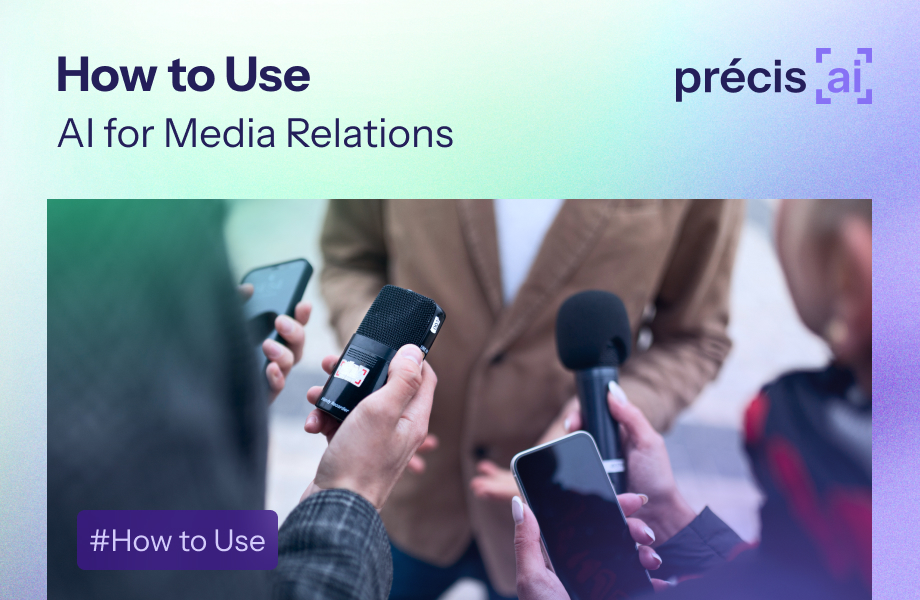
Artificial intelligence is reshaping media relations at every level. But as The Wall Street Journal pointed out in an AI/PR think piece, AI is creating an increase in ‘spam and artificial ‘experts’’ that require additional validation and verification steps from journalists. Not only does this tarnish the delicate relationship between the media and PR, but it can also rupture brand reputations (PR firms and clients, alike) if not careful.
When used correctly, AI helps PR professionals understand journalists better, personalize outreach, predict trends, and monitor brand mentions. And with the right approach, AI tools can become media assistants, analysts, and strategists all at once.
Do not stop at names and vertical beats when developing media lists. Use AI to dig deep into a journalist’s recent work. Ask it to analyze a journalist’s writing tone, recurring themes, story angles, and preferred sources. A well-trained chatbot can review fifty articles at one given time and quickly reveal patterns PR pros would otherwise miss.
To achieve this, try a prompt like:
“Summarize the key themes, tone, and timing of [journalist name]’s last 25 articles at [publication].”
This AI prompting technique will produce better outputs and enable PR professionals to personalize pitch notes that feel natural and less forced to the media target.
Forget inserting a name into an email pitch template. Use AI to angle the story directly to what a journalist cares about.
Try:
“Write a concise, relevant pitch to [journalist] that references their latest article and offers our client as a source.”
Then refine it:
“Now make the tone sharper, the subject line bolder, and give it a timely hook.”
AI can scan Google Trends, Reddit, trade newsletters, and niche blogs to find emerging themes. Instead of reacting to the news, use it to lead the conversation for your brand.
Prompt AI with:
“What early-stage conversations are developing in the [industry] space this week?”
Ask follow-ups:
“Which of these are gaining traction across social media platforms?”
AI can track coverage in real time and flag stories that need attention, whether that be quote attributions or information corrections.
Go beyond alerts and ask AI:
“Sort all mentions of [client] this week by sentiment and reach.”
It will filter out noise and allow the focus to be on the headlines that move perception.
After a campaign, use AI to break down not just coverage, but performance.
Try:
“Analyze the full media impact of [campaign], including tone, reach quality, and recurring themes.”
Then dig deeper.
“Which pitch angle got the most traction and why?”
AI will not replace PR professionals media relations instincts. It will sharpen them. The result is not just better coverage – it is better strategy.
 Blogs
Blogs  Blogs
Blogs 
 Press Releases