Become a PR Powerhouse
Précis Best Practices, Tips and Shortcuts
 Back to Catalogue
 Blog
Blog
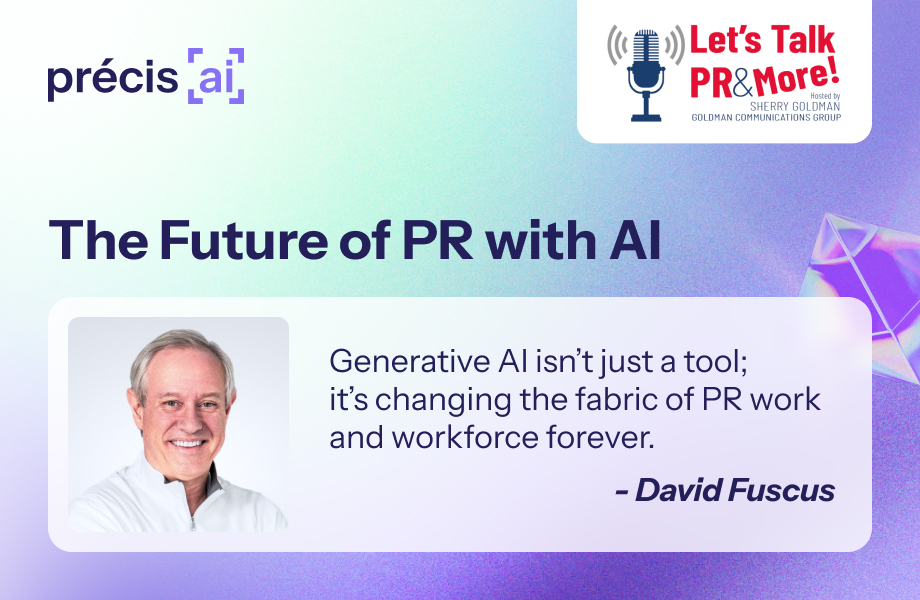
Public relations professionals find themselves at a pivotal juncture in the midst of a technological revolution. As influential voices in the industry offer guidance, they spotlight AI’s growing impact on PR. Recently, on the “Let’s Talk PR More” radio show, host Sherry Goldman engaged in an enlightening discussion with Précis AI’s CEO David Fuscus. Their dialogue explored AI’s transformative role in PR, touching on practical applications, evolving business models, ethical considerations, and what is necessary to thrive in the future PR landscape.
“Generative AI isn’t just a tool; it’s changing the fabric of PR work and workforce forever.” – David Fuscus
While the awareness of AI’s potential runs high across the communications sector, actual integration into daily PR workflows remains, surprisingly, inconsistent. As Fuscus and Goldman discussed, although many agencies tentatively explore chatbots or generalist AI tools like ChatGPT or CoPilot, few have adopted AI comprehensively across all teams. A noticeable hurdle? The phenomenon of “Draft Hell.”
In this scenario, rather than streamlining tasks, some PR professionals wrestle with multiple AI-generated drafts requiring extensive edits, ironically increasing their workload rather than reducing it. Addressing this challenge involves not merely using AI but mastering sophisticated techniques for AI prompting and grounding, which involves guiding the technology to better understand context and intention.
So, what does this evolution mean for PR professionals’ skill sets? According to Fuscus, AI shifts the focus from conventional writing to refined editing and strategic direction. Future PR professionals need to excel not just in writing, but in training AI, guiding it to understand nuances, and polishing its outputs. Indeed, those investing time in mastering AI usage often see the most significant returns.
“Using AI well means knowing how to train it, guide it, and edit like a pro.” – David Fuscus
These technological advancements significantly affect business dynamics. As noted by Fuscus, content-heavy PR roles save up to 20% of their workweek with AI tools – revolutionary, as labor costs consume about 67% of average PR firm revenues. By lowering these expenses, agencies can improve profit margins, a crucial advantage in the highly competitive PR industry.
However, as operational efficiency increases, traditional billing models based on time will need to adapt. Fuscus envisions a shift towards value-based pricing rather than strictly hourly charges. Agencies that embrace these changes by rethinking billing strategies stand to maintain their competitive edge.
“AI is helping us stop over-servicing and start serving smarter.” – David Fuscus
Currently, AI excels in content repurposing. Imagine transforming a single press release into a variety of formats: a LinkedIn article, SEO-friendly blog post, or an Instagram update – all without fears of content duplication. What traditionally required hours, AI now accomplishes in minutes, extending both reach and creativity without overburdening teams.
“AI gives you double the content with a fraction of the time.” – David Fuscus
Nevertheless, with AI’s capabilities comes the obligation of responsible use. Clients deserve clarity regarding how AI is utilized in managing their communication strategies. While a broad declaration (e.g., “we use AI as a tool”) is adequate for transparency, protecting client data is vital. General AI platforms may keep user inputs indefinitely, posing a potential risk to sensitive information.
Précis AI circumvents such issues by employing “data vaults,” ensuring that only authorized users can access and manage client data securely. The choice of tools can be crucial for sustaining trust over time.
“You’ll want a map to the minefield of AI data security. Don’t wander in blind.” – David Fuscus
Despite AI’s capabilities, good judgment and policy structure remain irreplaceable. Agencies should invest in ongoing education and enforceable guidelines for AI use, ensuring every team member comprehends what actions are permissible and why. Cultivating a culture of continuous learning not only preserves competitiveness but also ensures regulatory adherence.
“Good training separates AI helpers from AI hazards.” – David Fuscus
AI is already altering the landscape of public relations, and its influence is only set to intensify. Those who welcome its potential, dedicate resources to training, and opt for ethical, tailored solutions like Précis AI will find empowerment, not obsolescence, in this burgeoning field.
By weaving AI into their strategies thoughtfully, PR professionals can harness powerful tools that augment their abilities, promising a future where AI technology and human expertise coexist and complement one another.
“AI isn’t replacing PR pros; it’s empowering the pros who know how to use it.” – David Fuscus

 Blogs
Blogs  Blogs
Blogs 
 Press Releases